
Laser vision correction
FlaplessSMILE LASIK in Korea, performed in Gangnam, Seoul
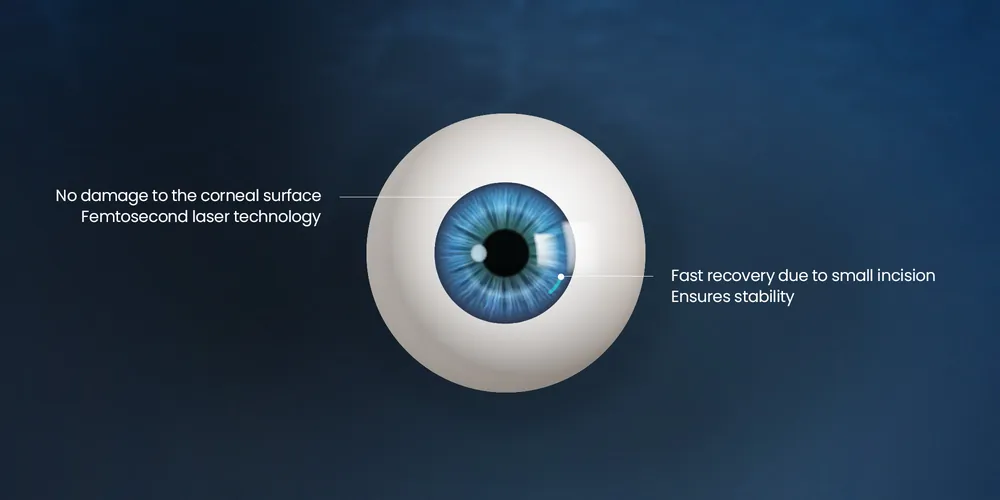
A small-incision laser procedure that removes a lens-shaped piece of tissue inside the cornea. No flap is cut. Bright Eye Clinic has performed more than 100,000 SMILE procedures.
Does this sound like you?
- You are tired of glasses or contact lenses, and want a procedure with a short recovery.
- You have dry eyes and worry surgery will make them worse.
- You are flying in from abroad and have only a few days in Seoul.
How SMILE LASIK works
The laser creates a lenticule inside the cornea. The surgeon removes it through a small incision of 1.5–2 mm. The femtosecond laser is made by ZEISS, and no flap is lifted.
Your eyes are measured in a full exam first, and that data is used to plan a customized SMILE treatment.
- Recovery: most patients can resume normal daily routine from the next day (clinic's comparison table: 1 day).
- Least invasive of the three laser options the clinic offers.
- Little pain or severe discomfort after surgery, according to the clinic.
- Reduces post-surgery dry eye, according to the clinic.
SMILE LASIK compared with LASIK and LASEK
| SMILE LASIK | Custom LASIK | Laser Fit LASEK | |
|---|---|---|---|
| Method | Intrastromal lenticule extraction (flapless) | Stromal ablation (flap) | Subepithelial ablation (layer removal) |
| Advantage | Minimum corneal damage, fast recovery | Relatively fast recovery | Resistant to external impact |
| Trade-off | Price | Weaker against external impact | Slow recovery, pain for a few days |
| Recovery | 1 day | 2–3 days | 5–7 days |
Source: clinic's own comparison. Price is listed as SMILE's trade-off. The clinic does not publish a price list, so ask about pricing when you contact us.
SMILE options at Bright Eye Clinic
The clinic offers SMILE in several tiers. Your doctor recommends one after your exam.
- Triple SMILE: strengthens the cornea to increase stability.
- Quattro SMILE: replenishes moisture to reduce discomfort.
- Core SMILE: strengthens the cornea to increase stability.
- Prime SMILE: replenishes moisture to reduce discomfort.
- Signature SMILE: adds platelet-rich treatment with 8 times more concentrated platelets.
- Bright SMILE Pro: performed on the newer VisuMax 800 by a doctor with 10+ years of SMILE experience.
Why patients come to this clinic for SMILE
- 100,000 SMILE procedures, certified at ZEISS headquarters.
- According to the clinic, the first in Asia to install the VisuMax (2009).
- Three VisuMax lasers on site.
- Patients from more than 40 countries. Interpreters and an international patient coordinator.
Before and after your surgery
- Stop wearing contact lensesRigid or toric lenses: 2 weeks. Soft lenses: 5 days. Ortho-K lenses: 1 month.
- Exam and planA comprehensive exam checks corneal thickness, how much tissue can be removed safely, endothelial cell health and astigmatism.
- Surgery dayNo makeup other than basic skincare, no perfume or hairspray. Wear comfortable clothes. Do not drive afterwards.
- Follow-upA check-up within 1–2 weeks, then optional unless your vision changes. Annual eye exams are still recommended.
Frequently asked questions
How long does the procedure take?
SMILE involves creating a lenticule within the cornea using a femtosecond laser and then removing it through a small incision. The laser application time is approximately 23–30 seconds per eye. With the upgraded SMILE Pro, which uses the VisuMax 800, the same surgical technique is performed with improved laser performance. As a result, the laser treatment time is reduced to approximately 10 seconds per eye, allowing for a faster and more precise procedure.
When will my vision improve after surgery?
After SMILE surgery, vision may be slightly blurry on the day of the procedure. However, most patients experience clear vision starting the next day. Temporary symptoms such as glare, halos, or dry eye may occur depending on corneal healing and dryness, but these typically improve within 1–2 weeks. Vision generally stabilizes during this period, with final visual outcomes achieved within 1–3 months. Recovery speed and visual outcomes vary depending on individual eye conditions and preoperative vision. Additional treatments such as corneal strengthening or dry eye management treatments may help enhance recovery and surgical results.
Are there any side effects after surgery?
After SMILE surgery, temporary side effects such as glare, nighttime halos, and dry eye symptoms may occur. In most cases, these resolve naturally within a few weeks and can be managed with artificial tears or prescribed medications. In rare cases, visual recovery may be slower, or a small residual refractive error may remain. If necessary, enhancement procedures can be performed. Serious complications such as corneal inflammation or opacity are extremely rare and are typically treatable with medication when detected early.
Can astigmatism be corrected as well?
Yes. SMILE can correct astigmatism in addition to nearsightedness. Advances in technology and clinical research now allow for the treatment of higher levels of astigmatism than in earlier years. However, candidacy and the most suitable procedure can only be confirmed after a thorough preoperative evaluation.