SMILE Pro LASIK Side Effects: Afraid of Dry Eye and Night Halos? Cost, Reviews and Methods
After SMILE Pro, glare, night halos and dry eye are the usual side effects, and most ease within a few weeks. Slower recovery or a small leftover prescription is rare, and serious corneal problems are extremely rare.
Afraid that SMILE Pro LASIK side effects like dry eye or night halos will follow you home and never fade?
Stay with me before you decide either way.
You'll see how long each effect usually lasts, what reviews claim, which methods exist if the risk doesn't sit well with you, and what decides the cost. Then you can weigh SMILE Pro against your job, your nights and your budget.
Hello, I'm Dr. Hyun Chul Cheon, Representative Director at Bright Eye Clinic Gangnam. My record lists 140,000 vision correction surgeries, 50,000 of them SMILE.
At our clinic, SMILE Pro runs on the ZEISS VisuMax 800, in the hands of a doctor with more than 10 years of SMILE experience. We have interpreters for international patients and hold KAHF accreditation for 2025–2029.
I wrote this because people often read that SMILE Pro is faster and assume a faster laser means a recovery with nothing to feel.
Most effects are temporary: glare, night halos and dry eye usually ease within a few weeks. Slower recovery or a small leftover prescription is rare, and serious corneal problems are extremely rare, though no surgeon can promise you won't be the exception.
If one of these is the reason you've put this off for years, name it in a WhatsApp message with a photo of your prescription, and ask how it applies to eyes like yours. You can ask before booking anything.
A faster laser shortens the laser step. It doesn't remove the healing that follows. SMILE and SMILE Pro are the same lenticule technique, and the difference lies in the VisuMax 800.
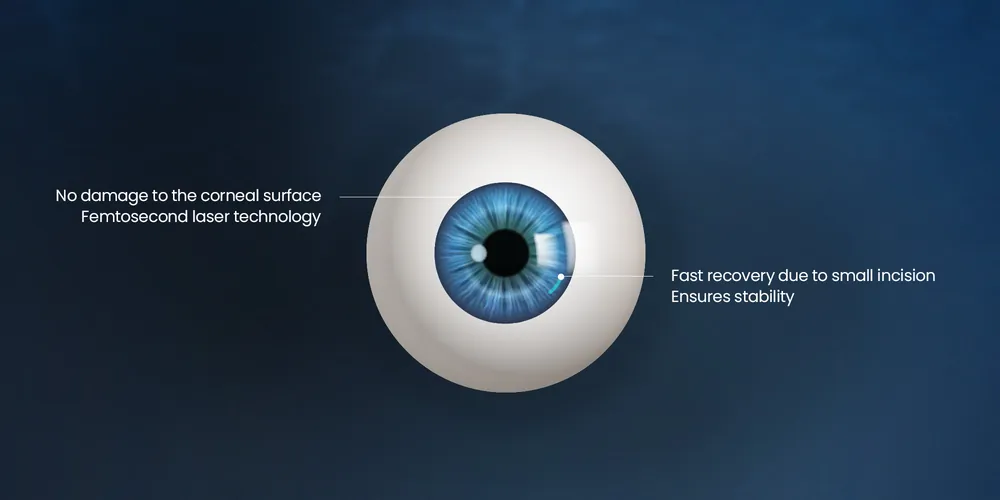
In SMILE, a femtosecond laser shapes a thin disc of tissue inside the cornea, and that disc is removed through a small incision with no flap. Laser time is approximately 23–30 seconds per eye for SMILE and approximately 10 seconds per eye for SMILE Pro. The VisuMax 800 also brings enhanced eye tracking and centration, and improved astigmatism correction.
Those advances matter for placing the treatment.
How long does each effect usually last?
The first day is often slightly blurry, and most people see clearly from the next day. Glare, halos and dryness typically improve within 1–2 weeks, and final outcomes arrive within 1–3 months.
Recovery speed and the final result differ with your eye condition and your prescription before surgery. A reading from day three tells you little about month three, which is worth remembering if you find yourself checking street lights every evening.
When
What's common
What it means for you
Day of surgery
Slightly blurry vision
Don't drive, and plan on a ride or public transportation
Next day
Clear vision for most people
Some blur, glare or dryness can remain
Weeks 1–2
Glare, halos and dryness improving
A follow-up check is typically performed in this window
Months 1–3
Vision reaching its final level
Judge your result at this point
Dry eye is the one I'd prepare for
Dry eye is the most common reason vision seems to dip after surgery, more common than the prescription actually returning. It usually improves with care, starting with artificial tears and, when needed, prescribed medication.
The mechanism is straightforward. The corneal nerves help signal your eye to make tears and to blink, and any laser correction disturbs some of them for a while. SMILE leaves no flap, but it doesn't spare every nerve, so the dryness can still show up.
This matters most if you already have tired, dry eyes. Long hours at a screen, air conditioning and years of contact lenses can all add to it. If your lenses already feel dry by evening, say so during your exam, because lifestyle is part of how a procedure gets recommended.
The question I'd want answered is how much dryness your daily life can tolerate for a few weeks, because that is usually the effect you notice. Your exam findings and the way you use your eyes both go into my recommendation, and I'd rather name LASEK or an ICL implant as an alternative than steer you toward a procedure that doesn't fit.
Dr. Hyun Chul Cheon
Night halos, and what they mean if you drive after dark
Halos and glare around lights are common early on and usually fade within weeks. Rarely, they stay noticeable for longer, which is why night driving deserves a direct conversation before surgery.
Say you're 33, you drive home after dark, your prescription is around -6.00 with some astigmatism, and your pupils are on the large side. Larger pupils are on the FDA's list of factors that may raise your LASIK risk, and it's reasonable to carry that caution over to SMILE. I'd want your corneal thickness and astigmatism in front of me, and I'd ask how many nights a week you actually drive. I'd also suggest you avoid getting behind the wheel at night until your vision feels steady to you.
If night driving is your main fear, add it to your WhatsApp message along with your prescription, and ask what you should watch for in the first weeks.
A lid speculum gently holds your eye open so you can't blink, and the laser's fixation and tracking systems monitor and compensate for eye movement in real time.
In extremely rare cases where fixation is lost, the surgeon decides whether to continue safely or convert to another method such as LASEK. I'd tell you this up front because it's the real answer to "what if I move": a plan exists for that moment, and you may end up with a different procedure and a different recovery.
The less common problems, and what happens next
In short, these are rare, but you should know them before you agree to surgery:
We don't publish a complication percentage, so I won't quote you one. Near vision is a separate matter too. Presbyopia isn't directly related to vision correction surgery and may still arrive with age, and clouding of the eye's lens is another separate process, covered in our guide to cataract lens choices. The American Academy of Ophthalmology's LASIK overview is a useful independent read on dryness, glare and correction errors in laser surgery generally.
Myopic regression. Part of the nearsightedness comes back as the cornea changes. If needed, an enhancement such as LASEK or ICL may be considered, depending on the remaining corneal tissue.
A small residual error or slow recovery. Sometimes vision takes longer to settle, or a small prescription remains. An enhancement can be performed if needed.
Corneal inflammation or opacity. These are extremely rare and are typically treatable with medication when detected early, which is why you shouldn't sit on worsening symptoms.
Who should skip or delay SMILE Pro?
People with severe dry eye, an autoimmune condition, or a thin or irregularly shaped cornea need a careful look first, and some of them shouldn't have laser surgery at all.
The exam weighs corneal thickness, the amount of tissue that can be safely removed, endothelial cell health, your eye anatomy, astigmatism and your overall eye condition. Tell the doctor about heart medication or blood thinners such as aspirin at the consultation. They may need to be stopped about a week before surgery.
What other methods are there if the risk doesn't suit you?
If SMILE isn't suitable, the usual alternatives are LASEK or an ICL implant, and each swaps one set of risks for another.
What reviews say about side effects, and what to believe
A few claims show up again and again in reviews, and they deserve a straight answer:
"No flap, so no dry eye." False. A flapless procedure can still leave you with temporary dryness.
"Perfect vision the next morning." Partly true. Most people see clearly the next day, but vision keeps settling for up to 1–3 months, and nobody can promise a particular acuity.
"The halos never went away." This is uncommon, since halos typically improve within weeks. A review can't tell you how close that person's eyes are to yours, though, and your pupils and prescription are what to discuss.
What decides the cost of SMILE Pro?
We don't publish a price list, so you'd ask for a quote on your own case. The method comes first, since SMILE and SMILE Pro are listed separately. Then comes the tier: Bright SMILE Pro, for instance, is performed on the VisuMax 800. Added treatments matter too, such as corneal strengthening or dry eye management, along with your days in Seoul.
For how those factors work in a wider laser quote, see what moves the number for LASIK in Korea. To get your own figure, ask on WhatsApp what SMILE Pro would cost for your case, with your prescription attached.
If something feels wrong once you're home
For pain, redness that keeps worsening or a sudden drop in vision, see an ophthalmologist where you live promptly, then contact the clinic. Don't talk yourself into waiting for your next check.
Before you leave home, the CDC's guidance for medical travelers suggests arranging follow-up care with a local provider, and carrying copies of your records helps that doctor. Fit the follow-up window into your plans with our Seoul trip checklist. I also encourage a comprehensive eye exam every year, surgery or no surgery, because the retina and optic nerve affect your vision too.
Your first message can be one sentence
You don't have to explain years of hesitation. Send a photo of your glasses prescription on WhatsApp with one line naming the side effect you fear most, and ask what would make you more or less prone to it. When you come, the doctor examines your eyes and recommends the procedure that fits your results and your daily life.
Results vary by individual, and your exam decides which procedure is proposed.
It can, at least for a while. Dryness after surgery is common and is usually managed with artificial tears or prescribed medication. Mention existing dryness during your exam, since it's part of deciding which procedure suits you.
Will I need reading glasses because of SMILE Pro?
Presbyopia, the age-related difficulty with near vision, isn't directly related to vision correction surgery. It may still arrive with age whether or not you've had surgery.
How soon is the first check after surgery?
After SMILE, a follow-up is typically performed within 1–2 weeks to evaluate healing. Further visits are optional unless you notice significant changes in vision or discomfort, though a comprehensive eye exam every year is still strongly recommended.
Does SMILE Pro treat astigmatism too?
SMILE can correct astigmatism along with nearsightedness, and SMILE Pro's VisuMax 800 offers improved astigmatism correction. Whether it suits your amount of astigmatism can only be confirmed after a thorough preoperative evaluation.
Can corneal strengthening reduce the risk of problems later?
Corneal strengthening (CXL) uses riboflavin and controlled ultraviolet light to strengthen the cornea's collagen fibers.