Planning your trip
Planning vision correction surgery in Seoul: a trip checklist
From the first message to the check-up afterwards: the steps, the contact lens rules and the airport route, in the order you will meet them.

Planning your trip
Bright Eye Clinic Gangnam publishes no price list or booking fee, so ask what the fee covers and what happens to it if the exam rules out SMILE. Then plan around lens-free days, closed days and a follow-up within 1–2…
Worried that a Korea SMILE LASIK consultation booking fee could be lost if the exam rules out surgery after you've already flown in?
Read this before you pay anything or book a flight.
You'll know what to ask about the fee, which methods could replace SMILE, what reviews get right and wrong, and how recovery fits your days off. That helps you choose dates and a budget that still work if your eyes need a different plan.
Hello, I'm Dr. Hyun Chul Cheon, Representative Director at Bright Eye Clinic Gangnam. I'm an ophthalmology specialist certified in ICL and SMILE, with a posted record of 140,000 vision correction surgeries, 50,000 of them SMILE.
We have 3 VisuMax lasers on site, interpreters for international patients, and KAHF accreditation for 2025–2029, Korea's program for hospitals serving foreign patients.
I'm writing this because people tend to compare fees first, when the dates they choose can cost them more.
Our site publishes no booking fee and no price list, so ask for the current terms directly before you pay: the amount, what it covers, and what happens to it if SMILE doesn't suit you.
Send a photo of your current prescription and your travel dates on WhatsApp, with one question: "If the exam says SMILE doesn't suit me, what happens to my booking fee?" One photo is enough, and you can ask before booking anything.
Forum figures describe other clinics and other years, so they can't settle this for you. Three answers from the clinic you're actually booking will. Keep them in your chat history next to your flight details.
The second question matters most, for a medical reason.
I can't tell anyone SMILE is right for them before a comprehensive exam, and a prescription alone won't settle it. It doesn't show your corneal thickness, how much tissue can be safely removed, the health of your corneal endothelial cells, or your eye anatomy. A high prescription on a thin cornea is where I would slow down, because the laser has to remove more tissue from less.
If SMILE isn't suitable, LASEK or an ICL implant may be recommended. Each has a trade-off. LASEK usually means a slower, more uncomfortable first few days. ICL is an operation inside the eye, with risks the FDA lists for phakic lenses, such as cataract and raised eye pressure.
If you have an older exam report that shows corneal thickness, send a photo of it on WhatsApp and ask whether the exam and any surgery can fall within the same trip.
Send your prescription and travel dates on WhatsApp
Plan your trip so a change of method doesn't ruin it. A different recommendation can mean different recovery days, so I'd want you to have thought about that before you land. Sometimes the right answer is no surgery on this trip, and that's a useful thing to learn from an exam.
Dr. Hyun Chul Cheon
In short, this catches people out more than the fee does. Lenses have to come out before the exam as well as before surgery, so the clock starts at home.
The CDC's medical tourism advice is to see your own healthcare provider at least 4–6 weeks before the trip. That visit is a good moment to ask your eye doctor whether they would see you after surgery abroad, since the same page tells travelers to make sure follow-up care is available at home.
| Lens type | Stop at least | Where that puts you |
|---|---|---|
| Soft | 5 days | Often the last days before you fly |
| Rigid or toric | 2 weeks | Working in glasses at home first |
| Ortho-K | 1 month | Planned well before you travel |
Work it out from the follow-up visit. After SMILE, a check-up is typically performed within 1–2 weeks, so if you want that visit in Seoul, your return flight has to land after it. A long weekend doesn't allow for that.
Say you wear toric lenses, live in Vancouver and have about two and a half weeks off. Your glasses go on two weeks before the exam date. You land on a Sunday, when we're closed, so Monday morning is your first possible visit. Wednesday is also closed, so leave it out of your plans.
If surgery falls in that first week, your second week holds the check-up, and you book the flight home after it. Ask us to confirm the dates before you buy a ticket. Our hours are Monday, Tuesday, Thursday and Friday 9:30 AM to 6:30 PM, Saturday 8:30 AM to 5:00 PM, with lunch from 1:00 to 2:00 PM.
For packing and the rest of the logistics, keep this Seoul trip checklist for vision correction open while you book.
On surgery day, vision may be slightly blurry. Driving isn't recommended, so use public transportation or arrange a ride, and I'd strongly encourage bringing a companion. Most patients see clearly from the next day.
Glare, halos or dry eye can appear and typically improve within 1–2 weeks. Vision generally stabilizes during that period, with final results within 1–3 months. So your last days in Seoul can include sightseeing for many people, but your final vision will usually arrive after you're home.
Ask your doctor when you can fly. The CDC's 10–14 day air travel advice is written for major surgeries, so raise it directly for your procedure.
SMILE and SMILE Pro use the same lenticule technique; the laser differs. Laser time is about 23–30 seconds per eye on the VisuMax and about 10 seconds on the VisuMax 800. SMILE also comes in several tiers at our clinic, including Core, Prime, Signature and Bright SMILE Pro, and your doctor recommends one after the exam.
If you want LASIK and LASEK in the picture too, here's how SMILE, LASIK and LASEK compare. SMILE doesn't address near vision. Presbyopia can still arrive with age, whether or not you've had surgery, and readers past 40 may want to read about presbyopia lens surgery options first.
Our price table is quote on request, so your figure comes from these factors:
The factors behind LASIK cost in Korea work in a similar way. On WhatsApp, ask what it would cost for your case, and whether that quote includes the exam and the follow-up visit.
"I could see the next morning." Largely true for most people, but that's the start of recovery. Final results can take 1–3 months.
"No flap means no dry eye." Not accurate. Dry eye can occur after SMILE too, though it's usually temporary and manageable with artificial tears or prescribed medication.
"My booking deposit was kept" or "mine came back." Both can be true somewhere, because terms differ by clinic and year. A review tells you nothing about the terms you'd be agreeing to, so go back to the three questions above.
Glare, nighttime halos and dry eye are the common temporary effects, and in most cases they resolve within a few weeks. In rare cases, visual recovery is slower or a small refractive error remains, and an enhancement such as LASEK or ICL may be considered depending on the remaining corneal tissue. Serious complications such as corneal inflammation or opacity are rare and typically treatable with medication when caught early. Recovery speed and results depend on your eyes and your starting prescription.
The FDA's LASIK guidance lists people who are probably poor candidates, and much of it is worth raising for any corneal laser:
If you take heart medication or blood thinners such as aspirin, tell your doctor during the consultation, since they may need stopping about a week before surgery.
If pain, redness or a drop in vision appears after you're home, see a local eye doctor promptly and bring your records. The CDC advises getting copies of all your medical records before leaving, so collect yours before your flight.
A one-line WhatsApp message can start this: the lens type you wear, the weeks you could travel, and "Is the booking fee separate from the surgery cost?" When you come, the doctor examines you and recommends the procedure that fits your eyes and the way you live.
Results vary by individual, and your exam decides which procedure is proposed.
Planning your trip
From the first message to the check-up afterwards: the steps, the contact lens rules and the airport route, in the order you will meet them.
Laser vision correction
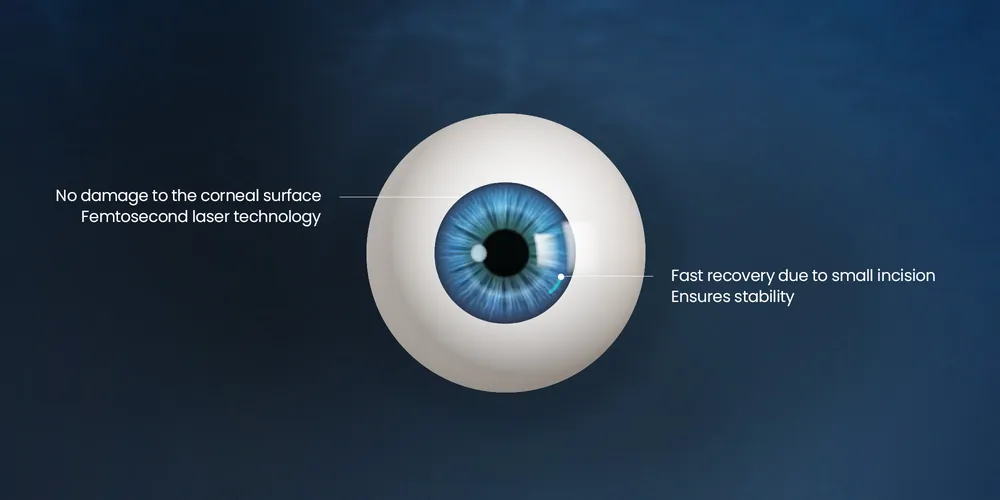
Three laser options, three different trade-offs. A side-by-side look at method, recovery time and who each one tends to suit, using the clinic's own comparison.
Lens surgery
Close-up vision fades because the lens stiffens, not because of laser surgery. Here is how monofocal and multifocal lenses differ, and what ArtiPlus is.