Planning your trip
Planning vision correction surgery in Seoul: a trip checklist
From the first message to the check-up afterwards: the steps, the contact lens rules and the airport route, in the order you will meet them.

Laser vision correction
Book a SMILE consultation in Korea when your prescription has held steady for about a year, your lenses can stay out for the required days, and your trip leaves room for follow-up within 1–2 weeks.
Worried that a Korea SMILE LASIK consultation booking appointment could end with flights paid for and an exam report that says no?
Read this before you pay for the ticket.
You'll know what decides the cost, what reviews get right and wrong, which methods remain if SMILE doesn't fit, and who should hold off. That should help you pick dates that suit your eyes and your budget.
Hello, I'm Dr. Hyun Chul Cheon, Representative Director at Bright Eye Clinic Gangnam, an ophthalmology specialist certified in ICL and SMILE.
Our clinic has 3 VisuMax lasers on site, offers SMILE, SMILE Pro, LASEK, Custom LASIK and ICL, and has interpreters for international patients.
I wrote this because many people plan a short trip around a surgery date and treat the exam as a formality, when the exam can still point to another procedure.
A Korea SMILE LASIK consultation booking appointment makes sense when your prescription has held steady for about a year, your lenses can stay out for the required days, and your trip leaves room for follow-up.
On WhatsApp, send a photo of your latest prescription with the dates you have in mind, and ask one question: which lenses do I need to stop, and when? One photo is enough, and you can ask before booking anything.
I'd hold off if your prescription is still moving, your cornea is thin or irregular, you're pregnant or nursing, or your dry eye is already severe. Each one changes the risk or the accuracy of the result, and none of them is solved by a faster laser.
The FDA's list of reasons LASIK may not suit you is written for LASIK, but most of its reasoning carries over to any laser correction of the cornea. These are the situations I would want you to think through first:
I won't name a procedure for you before the exam. Corneal thickness, the amount of tissue that can be safely removed, endothelial cell health, your eye anatomy and astigmatism all go into that decision, along with how you use your eyes every day. If SMILE is not suitable, LASEK or an ICL implant may be what I recommend instead.
Dr. Hyun Chul Cheon
For most trips, a long weekend is tight for surgery. We're closed on Wednesdays and Sundays, and a follow-up check after SMILE is typically performed within 1–2 weeks, so the calendar matters as much as the eyes.
Say you're 27, working in Osaka, wearing toric lenses, with a Thursday-to-Sunday break. Thursday and Friday run 9:30 AM to 6:30 PM with a lunch break from 1:00 to 2:00, Saturday runs 8:30 AM to 5:00 PM, and Sunday we're closed. You would also spend the two weeks ahead of your flight in glasses.
Here is how I'd reason about it. Vision may be slightly blurry on the day of surgery, and most people see clearly from the next day, so the flight itself is rarely the sticking point. The follow-up is. Your break ends on Sunday, and that check falls one to two weeks out. Before you buy the ticket, ask where that check can happen for you. A longer break settles the question, and our Seoul trip checklist for vision correction helps you lay the days out.
If you're still working out the dates, message us on WhatsApp with your lens type and the days you can travel, and ask which appointment day fits them.
Send your prescription and dates on WhatsApp
Contact lenses temporarily change the shape of the cornea, and the exam is measuring that shape. Stop them for at least this long, for the examination as well as for surgery:
Count backward from your appointment and you may find the real start of your trip is weeks earlier than the flight. If you can't manage your job in glasses for that stretch, move the dates. Avoid excessive fatigue and alcohol before surgery as well.
On the day of surgery, skip makeup other than basic skincare, along with perfume and hairspray, since these may interfere with the laser equipment. Wear something you can lie down in comfortably, and leave the hoodie, short skirt and boots at your hotel. Driving afterward is not recommended, so plan on public transportation or a ride. Coming with a companion is strongly encouraged.
| Lens type | Stop at least |
|---|---|
| Rigid (hard) or toric | 2 weeks |
| Soft | 5 days |
| Orthokeratology (Ortho-K) | 1 month |
The alternatives on our menu are SMILE Pro, Custom LASIK, LASEK and the ICL implant. Each treats the eye differently, so each brings its own trade-off.
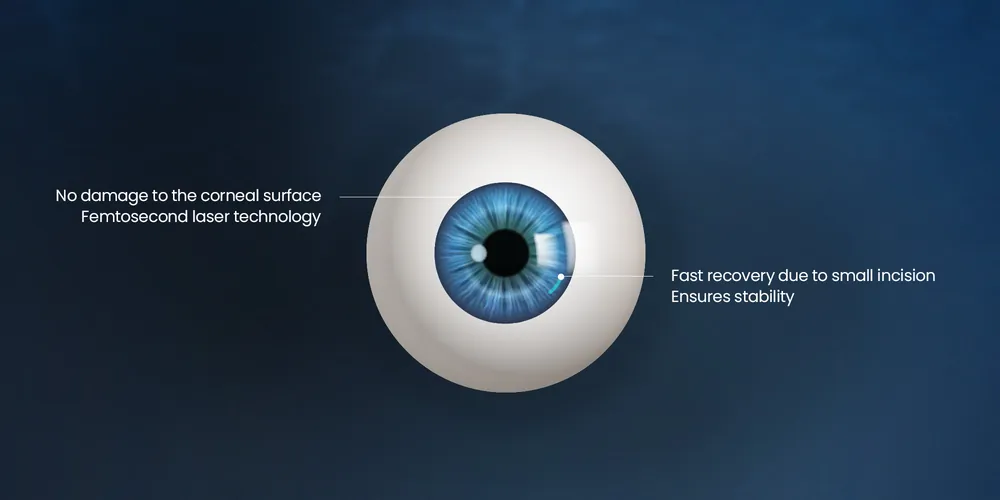
SMILE and SMILE Pro use the same lenticule technique, and SMILE Pro runs on the VisuMax 800 laser. Custom LASIK uses a flap and the Amaris Red excimer laser. LASEK works on the surface of the cornea with no flap, and it generally means more early discomfort and a slower visual recovery. ICL leaves the cornea alone by placing a lens inside the eye, which brings risks of its own, including cataract and raised eye pressure.
Our side-by-side look at SMILE, LASIK and LASEK covers the laser options in more depth. If you're past 40 and near vision is already fading, know that presbyopia comes from the eye's own lens stiffening with age, and it can still arrive after any vision correction. Presbyopia lens surgery options may be a more useful thing to read first.
Reviews tend to be right about the speed of the laser and the next-day vision, and less reliable about how long healing takes.
We don't publish a price list, so the figure comes as a quote for your case. These are the things that move it:
What moves the number for LASIK follows much the same logic. To get the figure for your own case, ask on WhatsApp what it would cost, and include your prescription.
After SMILE, temporary glare, nighttime halos and dry eye may occur, and in most cases they resolve within a few weeks with artificial tears or prescribed medication. In rare cases, recovery is slower or a small residual error remains, and an enhancement may be considered depending on the remaining corneal tissue. Serious complications such as corneal inflammation or opacity are extremely rare and are typically treatable with medication when detected early. Recovery differs from one person to the next.
If something feels wrong after you've flown home, such as pain, redness that keeps getting worse, or a sudden drop in vision, see an ophthalmologist where you are promptly, then contact the clinic. The CDC's advice for medical travelers includes arranging follow-up care at home before you leave and carrying copies of your records, and I'd do both. Annual comprehensive eye exams are worth keeping up too, since the retina and optic nerve affect your vision as much as the cornea does.
Start with the two things that shape everything else: what lenses you wear and when you can travel. On WhatsApp, send your lens type and your possible dates, and ask how far ahead you should stop wearing them. If you have an old exam report, a photo of that page is enough for a first message, and you can ask anything before you book. When you come, the doctor examines your eyes and recommends the procedure that fits them and the way you live.
Results vary by individual, and your exam decides which procedure is proposed.
Planning your trip
From the first message to the check-up afterwards: the steps, the contact lens rules and the airport route, in the order you will meet them.
Laser vision correction
Three laser options, three different trade-offs. A side-by-side look at method, recovery time and who each one tends to suit, using the clinic's own comparison.
Lens surgery
Close-up vision fades because the lens stiffens, not because of laser surgery. Here is how monofocal and multifocal lenses differ, and what ArtiPlus is.